For decades, document processing was synonymous with manual data entry, endless filing cabinets, and human error. But a new wave of technology is washing over the enterprise: Artificial Intelligence. We are witnessing a paradigm shift from static, manual workflows to dynamic, automated intelligence.
This isn't just about speed; it's about unlocking the trapped value within unstructured data. Let's explore how AI is redefining the future of work.
"The future of business isn't just paperless; it's data-rich. AI turns every document into a structured database."
Beyond OCR: The Era of Intelligent Document Processing (IDP)
Traditional Optical Character Recognition (OCR) was groundbreaking in its time, converting images of text into machine-encoded text. However, it lacked context. It couldn't tell the difference between an invoice number and a phone number.
Enter Intelligent Document Processing (IDP). Powered by Natural Language Processing (NLP) and Machine Learning (ML), IDP doesn't just "read" text; it "understands" it.
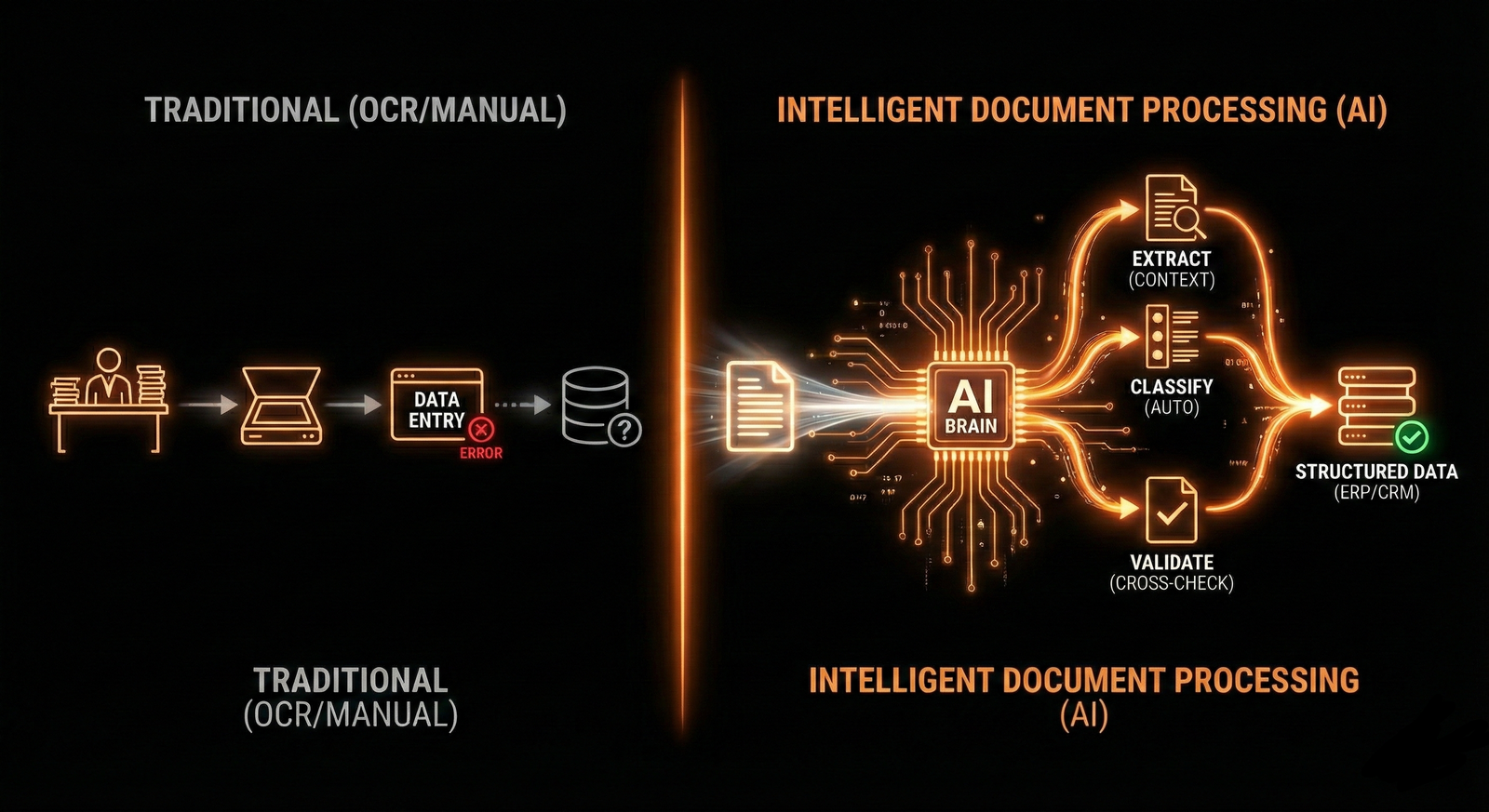
Core Capabilities of Modern IDP
- Contextual Extraction: AI can identify specific entities (dates, names, amounts) regardless of where they appear on the page.
- Classification: It automatically sorts documents into categories (e.g., Invoices, Contracts, Resumes) without human intervention.
- Validation: The system can cross-reference extracted data with internal databases (e.g., checking a PO number against an ERP system) to ensure accuracy.
The Impact on the Future of Work
The integration of AI into document workflows is not about replacing humans; it's about augmenting human potential. By automating the "grunt work" of data entry and verification, professionals are freed to focus on higher-value tasks.
- Reduced Operational Costs: Automation drastically cuts the cost per document processed, often by up to 80%.
- Faster Turnaround Times: What used to take days (e.g., loan approvals, insurance claims) can now be processed in minutes.
- Enhanced Compliance: AI leaves a perfect digital audit trail, ensuring that every step of the process is logged and traceable for regulatory purposes.
As we look toward 2026, the companies that embrace AI-driven document processing will possess a significant competitive advantage: the ability to move at the speed of data.